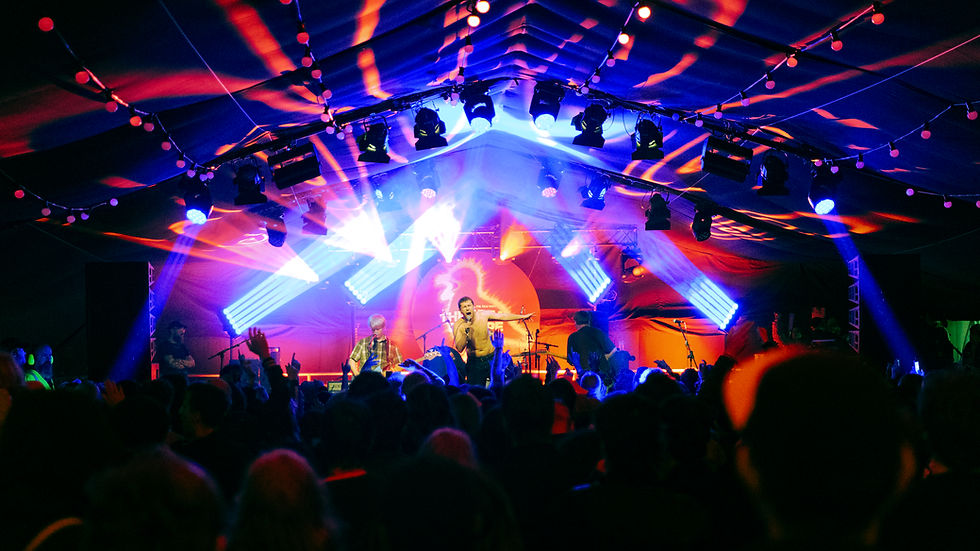
Shake The High Road 2026


Five iterations in, Shake The High Road has firmly established itself as a vital fixture in East London's cultural calendar. This year’s sold out edition unfolded across St Mary’s Church, Leytonstone Social, and The Red Lion ballroom, turning Leytonstone High Road into a multi-venue celebration of emerging music. The lineup struck a careful balance between new discoveries, local artists, and well-loved names from across the UK circuit, all tied together by a clear passion for the scene it represents. In doing so, the festival continues to fill a gap in East London’s cultural fabric - creating space for grassroots music and genuine community connection.
The downstairs stage at Leytonstone Social bore the unmistakable imprint of Dreamhouse Records, whose curation brought a real sense of cohesion and purpose to the space. Set within an ex working men’s club now revitalised as a venue, the room carried a raw intimacy that suited the lineup perfectly; close quarters, low ceilings, and an audience fully locked in. Dreamhouse’s ongoing investment in local talent shaped a lineup that felt authentic and connected to the area. Local band Tansy set the bar high from the offset, opening the stage with confidence and flair, establishing a momentum of quality acts that carried on throughout the day.
The upstairs stage at Leytonstone Social, curated by Jess Iszatt from BBC Introducing, carried a different kind of weight throughout the day. Recorded sets were captured for broadcast on BBC Radio London, adding a sense of permanence to a room dedicated to emerging talent. The bill itself reflected the strength of the BBC Introducing ecosystem, spotlighting emerging artists already finding traction across both regional and national airwaves.
Simon A. opened the stage with a set that immediately settled the room. Blending elements of indie, soul, and rap, his set moved fluidly between melodic phrasing and rhythmic delivery, creating a hybrid sound that felt both contemporary and personal. There was a clear assurance in the way he held the space, not relying on spectacle but instead on precision and presence. As an opener, it worked perfectly - drawing the early crowd in and setting a measured, assured tone for what followed.
A clear highlight of the BBC Introducing stage came from Cass Why, whose set felt far beyond a debut performance. With a noticeable turn in energy, things got louder, livelier and more expansive as his set pushed the room into a different gear entirely. For his first show, the confidence and control on display were remarkable, with a presence that held the room from start to finish. It was one of those rare introductions that feels like the beginning of something much larger.
Across the day, the festival made a strong case for breadth and inclusivity, with a programme that moved confidently between styles, moods, and scenes without ever feeling disjointed. From electronic experimentation and live instrumentation to indie, rap, and genre-fluid performances, there was a genuine sense that every corner of contemporary music had a place somewhere on the bill. It created an atmosphere of discovery, where audiences could drift between stages and consistently find something unexpected, something challenging, or something instantly familiar. It was a reminder that the strength of the event lies not only in its local roots, but in its openness: a space where different sounds coexist, and where there is always something new waiting to be found.
Frost delivered one of the most striking shifts in atmosphere downstairs at Leytonstone Social, completely reconfiguring the room’s energy with an experimental live drumming performance. Under pulsing strobe lighting, the space took on an almost disorienting intensity, with flashes of light cutting through the crowd as the rhythms grew more intricate and physically demanding. His playing was sharp, unpredictable, and immersive, drawing people into a kind of collective focus where sound and movement felt inseparable. It was a visceral, atmosphere-altering set that transformed the downstairs stage into something closer to a shared sensory experience than a traditional live performance.
Back upstairs, Izzy Withers delivered one of the most quietly impactful sets of the day. Distinguishing herself through warm, soulful vocals and an effortless ease in her stage presence, her voice carried with a richness and clarity that expanded far beyond the confines of the room. Each phrase felt unforced yet deliberate, allowing the emotion in the songs to land naturally while the audience settled into a focused, attentive stillness. It was a performance that hinted strongly at what’s to come: a clear star in the making, already possessing the kind of presence and vocal identity that can set them apart.
Beyond the stages and lineups, what truly defines Shake The High Road is its atmosphere. The festival transforms Leytonstone into something electric - pubs, cafés, shops, and unexpected corners all humming with sound and conversation. DJs music rings out from the church courtyard as audiences drift between venues and musicians mingle with crowds,
Tenderness performed inside St Mary’s Church with a sense of stillness that immediately set it apart from the rest of the festival. The beautiful backdrop of the church framed a set that was soft, spacious, and emotionally attentive. Rather than building intensity, the performance focused on subtle shifts and delicate textures, allowing the audience to sink into its mood. It was a contemplative, immersive moment within the day.
As day turned to night, the upstairs ballroom at The Red Lion shifted into an entirely different mode - its atmosphere tightening, its lights dimming, and its energy sharpening into something more electric. The space transformed from the family zone into a late night pressure cooker of sound, where boundaries between genres began to blur.
Gold Panda delivered a headline set that brought a real sense of connection to the room. His music created a light, rhythmic pulse that spread quickly through the crowd, turning the ballroom into a shared space of movement and release. People were dancing freely, smiling, and fully absorbed in the rapturous atmosphere. Rather than a dramatic finale, it was a communal one, defined by ease, rhythm, and togetherness.
Looking ahead, the festival’s impact shows no signs of plateauing. The organisers’ involvement in opening a new local venue (provisionally named Seven Church Lane) signals a commitment that extends far beyond an annual event. It suggests infrastructure, permanence, and a long term vision for sustaining the community they’ve helped galvanise. If the first five editions were about proving what’s possible, the next chapter seems poised to deepen those roots - offering artists not just a stage for a day, but a home for the long haul. In a city that often forgets the value of its smaller scenes, Shake The High Road is a reminder that real cultural movements don’t just appear - they’re built, patiently and collectively, from the ground up.