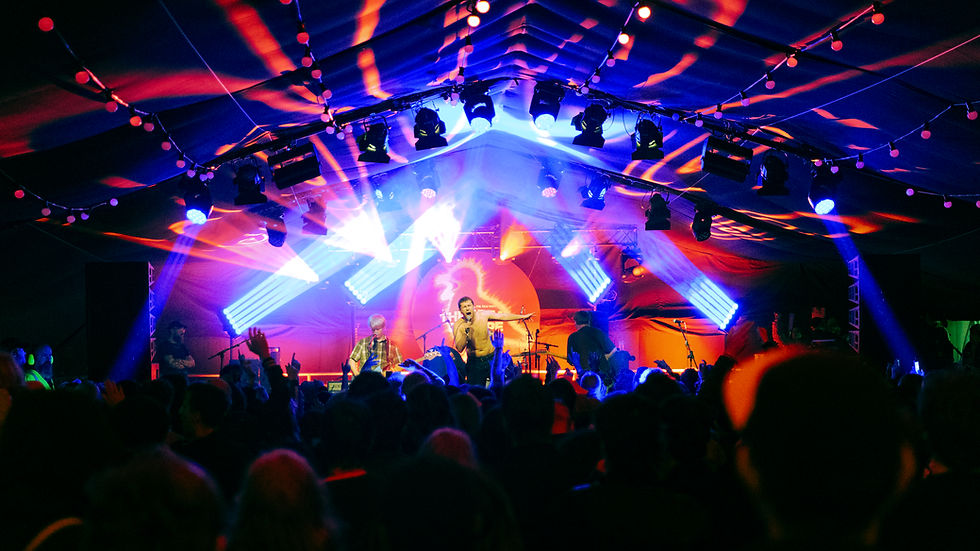
Wide Awake 2025: Turning Up The Volume On Change

Updated: Jun 20, 2025

Wide Awake Festival 2025 felt less like a fleeting spectacle and more like a love letter to London’s grassroots music community - fun, feel-good, and fiercely independent. Now in it's fifth year, the festival has become a centrepiece in any music lovers calendar. Held once again in Brockwell Park, the one-day event made a compelling case for how festivals can serve not just as entertainment, but as infrastructure for the scenes that feed them.
While many festivals are busy chasing scale, Wide Awake still feels plugged into the circuits that make London’s alternative culture tick. It wasn’t just the lineup - though the bill, stacked with DIY staples and rising underground acts, certainly proved the point. It was the atmosphere: the shared language of crate-diggers, zine-makers and post-punk aficionados alike.
Gurriers brought early-day fury with a set that really set the bar high. Their post-punk assault was jagged, urgent, and utterly unrelenting. It was noise with precision, energy with intent, and despite the chaos, it felt like every scream and serrated riff had a target. For a band on the rise, they commanded the stage with the confidence of a group already reshaping the landscape around them.
The same could be said for Sprints, who channelled righteous rage into tight, defiant anthems. Frontwoman Karla Chubb’s mighty croons set the scene as the bands set twisted between the dark and light of their impressive back catalogue.
Warmduscher brought pure, unfiltered chaos - the kind that makes you grin ear to ear. Their set was a sweaty explosion of sleaze-rock, disco funk, and unhinged charisma. Every song felt like a dare, every riff a wink. Frontman Clams Baker Jr. strutted and snarled through it all like a man hosting the wildest house party south of the river. It was messy, fun, and impossible not to dance to - the kind of set that reminds you festivals are meant to be a bit ridiculous, a bit chaotic, and a hell of a good time.
The politics that run through Wide Awake have always been more than aesthetic - and this year, they were brought to the forefront by the surprise appearance of Jeremy Corbyn. Taking to the stage without fanfare, he delivered a speech that drew a crowd not just of curious onlookers, but of people genuinely listening.
“What makes London such a very special place?” he asked, pausing to reflect. “When I think back of all the struggles of the Afro-Caribbean community in Brixton in the 1950s and 1960s… all those that suffered the most abominable racism within our society. Yet they fought back. They fought back through culture, through music, and through coming together.”
He continued: “We can declare our absolute abhorrence of racism in any form whatsoever - be it anti-black racism, islamophobia, antisemitism, or anything else. It is about bringing people together.” Corbyn also urged the crowd to join a mass demonstration on June 2nd to end austerity and poverty, reminding the crowd, “You can’t achieve equality and justice if you extol the virtues of billionaires and do nothing about taking money off them in order to pay for the needs and services of the many… It’s music for the many. It’s services to the many. And it’s hope for all of us.”
Then there was Nadine Shah - a reminder of what happens when grassroots artistry matures without compromise. Her set was a masterclass in tension and control, moving between jazz-tinged confessionals and politically pointed anthems. With a band as tight as it was textured, Shah's voice cut through the late-afternoon air with a clarity that felt almost jarring in its directness.
Getdown Services then arrived to shake things up. The Bristol duo brought a kind of chaos that felt both calculated and contagious - industrial synths clashed with camp post-punk energy, as the band tore through a set that veered between satire and sincere existential dread. Beneath the performance art and sardonic delivery, there was real bite, real anger, and real humour. They’re one of the few acts that can make you laugh, dance, and spiral in the same three-minute track.
This year, Wide Awake deepened its activist infrastructure through a partnership with Médecins Sans Frontières (Doctors Without Borders), bringing frontline humanitarian work into sharp focus. Throughout the day, MSF volunteers spoke with festival-goers about the organisation’s global medical efforts, but it was an early-afternoon address from field worker Jacob that brought the crowd to a rare, heavy silence.
Jacob described returning to Gaza in late 2023 to find a landscape devastated by constant bombing - a “field of ruins” filled with tents and makeshift shelters. He recounted a haunting story of a mother severely burned while trying to save her children from a bombed tent fire, a moment that stayed with everyone present. “I left Gaza profoundly depressed and angry,” he said. “What we see today is an abomination - a stain on human history. It has to stop.”
The inclusion of MSF at Wide Awake wasn’t performative - it was purpose-built. Festival-goers were able to contribute to medical efforts via contactless donation points, but more importantly, the space fostered connection, awareness, and urgency. It served as a reminder that festivals can be more than escapism - they can also be vessels for truth-telling, solidarity, and shared responsibility.
Among the more reflective moments, English Teacher carved out a pocket of quiet intensity in the day’s whirlwind. Frontwoman Lily Fontaine trembles as she reads aloud "I was reading an essay about grief by C.S. Lewis yesterday and it talks about how time itself is a sort of death. War as a concept will not die because we're human beings and man can't help itself, but this particular conflict will end. And when it does, like all others there will be those who took the side of the oppressor and those who took the side of the oppressed - and we are proud to share the stage with people who stand up against oppression."
She continued,"Art and protest have a long and beautiful history, not only because it allows us to communicate the realities of oppression, but it also allows us to imagine and make tangible what is not... The people at the top - they don't care about us, they care about themselves. So we have to defend each other, and we have to listen to each other. Free Palestine." It was a defining moment - deeply personal, political, and rooted in the very spirit Wide Awake has cultivated.
Launching into their set, English Teacher's woozy guitar lines and spoken-word delivery gave shape to a set that felt deeply considered and wholly unbothered by trends. Fontaine's vocals ring out with power. Watching them on the Wide Awake stage felt like witnessing a future headliner just before liftoff - one rooted in thoughtful, community-driven artistry rather than hype cycles.
While English Teacher are a tough act to follow - the fun-fuelled theatrics of CMAT certainly scratched the itch. Turning the main stage into her own rhinestone rodeo, her set was equal parts theatre and therapy - big vocals, bigger hooks, and a crowd that screamed every word like gospel. Whether she was delivering heartbreak anthems or tongue-in-cheek bangers, her charisma never wavered. With sun-soaked swagger and a healthy dose of melodrama, we can all be certain: CMAT summer has officially arrived.
This year’s Wide Awake line-up made one thing crystal clear: Irish bands are not just having a moment - they’re defining it. From the blistering intensity of Gurriers and Sprints to the subversive charm of CMAT, the presence of Irish artists felt both intentional and undeniable. These acts weren’t clustered into a novelty showcase; they were threaded throughout the day, shaping its sound, its politics, and its energy. It was a reminder that some of the most vital, uncompromising music right now is coming from across the Irish Sea.
Backstage, around merch stalls, and on the grass, the real heart of Wide Awake pulsed. Independent record labels, small press publishers, community organisers and gig photographers all had space carved out - not as add-ons, but as part of the architecture.
The festival’s ongoing legal entanglement with Lambeth Council, challenged by campaigners concerned about public park use, speaks to its place within a broader civic debate. Unlike many large-scale events that parachute in and leave no trace but litter, Wide Awake has made itself a stakeholder in London’s cultural and physical landscape.
In a city where grassroots venues are shuttering at an alarming rate and culture is increasingly filtered through algorithms and branding decks, Wide Awake stands as something rare: a large-scale festival that remembers where it came from - and refuses to forget who it's for.